Your Brain Is Hardwired to Lose Money—Here’s Why
Article 5
By Vipul Patel using Google AI Studio
11/22/20254 min read
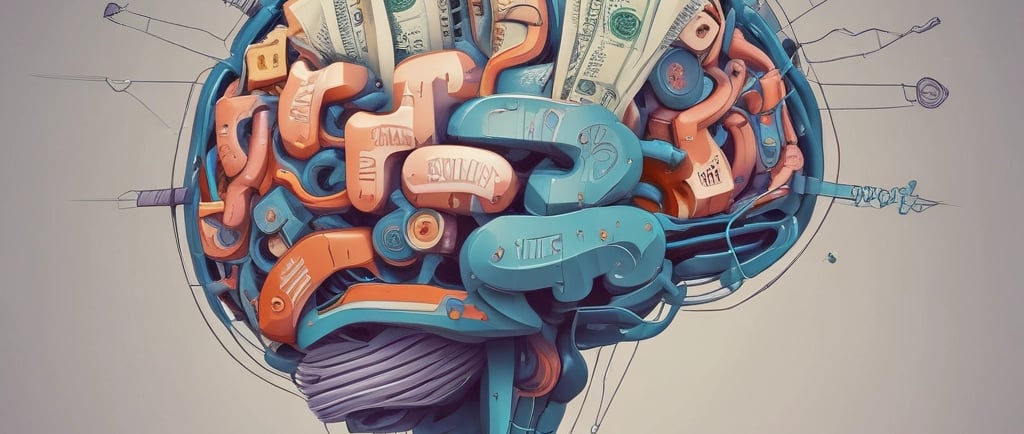
Your Brain Is Hardwired to Lose Money—Here’s Why
Introduction: The Invisible Force in Your Trading Account
Have you ever stared at your screen, watching a trade go against you, and wondered why you can't just follow your own rules? You know you should close the position, take the small loss, and move on. Yet, you hesitate, you hope, you bend the rules—and a small loss turns into a big one. You’re not alone.
The issue isn't a lack of knowledge, discipline, or a "mindset issue." The problem is a deep-seated biological bias that affects every trader, regardless of experience. It’s an invisible force in your account called "Loss Aversion," and it’s hardwired into your brain to make you feel the pain of losses far more intensely than the pleasure of gains. This article will explore the most impactful ways this bias shows up in your trading and what you can do about it.
1. The First Hard Truth: Your Brain Treats Financial Loss Like Physical Pain
Before you can fix the problem, you must understand its source. The tendency to make poor trading decisions under pressure is not a personal weakness. This isn’t discipline failure. This is human nature. Your nervous system reacts to financial loss in the same way it reacts to physical threats or pain.
Your body hates losing money.
This biological reality is the foundation of loss aversion. The central principle is simple but has profound consequences for your trading account.
The pain of losing is stronger than the pleasure of winning.
This isn't an abstract concept. It means a $200 loss carries significantly more emotional weight than a $200 gain feels good. It’s why a losing streak feels heavier than a winning streak feels rewarding. Your brain is not built to maximize potential; it is built to minimize pain, and this imbalance shapes nearly every decision you make in the market.
2. The Lethal Combination: You're Hardwired to Hold Losers and Cut Winners
Loss aversion creates two specific, predictable, and destructive trading behaviors that work in combination to destroy profitability.
First, you hold losing trades for far too long. Your planned stop-loss is hit, and the logical move is to close the trade and accept the planned loss. But loss aversion activates, and your brain screams, "Don't make it real!" or "It might bounce back!" So you hold on. You widen the stop. You ignore the rules. You hope instead of act, turning a controlled, manageable loss into significant financial damage.
Second, you cut your winning trades far too early. The exact same bias works in reverse. As soon as a trade moves into profit, a new fear emerges: "What if it reverses and this win turns into a loss?" This fear of a potential loss causes you to exit the trade early, sacrificing the possibility of larger gains for the certainty of a small, safe profit.
This combination is devastating to a trading account over time. It systematically undermines any edge your strategy might have.
Loss aversion makes your losers big and your winners small.
That combination is lethal.
3. The Ripple Effect: One Loss Infects Future Decisions
The damage from loss aversion doesn't end when you finally close a losing trade. After taking a loss, your brain becomes more protective and risk-averse. It wants to avoid the pain of another loss at all costs.
As a result, you hesitate. You see perfectly valid trade setups that align with your strategy, but you don't take them. You skip opportunities and break the consistency your trading plan requires to work over the long term. This is how loss aversion turns a single loss into multiple missed wins, compounding the negative impact on your account and your confidence.
4. The Hidden Trap: The Fear of Losing Is Worse Than the Loss Itself
A critical insight into this bias is that the anticipation of taking a loss often causes more emotional pain than the actual event of closing the trade. The real discomfort is in the moments leading up to the decision.
For example, actually clicking the button to take a -50 loss feels bad. But sitting there and watching the trade creep toward -50 feels far worse. It is this feeling that your brain desperately wants to avoid. To delay the moment of pain, your mind creates a storm of justifications: "It might reverse," "This candle looks weak," "The market is manipulated anyway," or "Let me just wait a bit more."
This internal monologue isn't based on market analysis; it's an emotional negotiation. This is the brain negotiating with pain, not with logic—a fatal flaw in the rule-based environment of the markets.
Conclusion: The Path Forward is Through Controlled Pain
From an evolutionary standpoint, this bias makes perfect sense. For a hunter-gatherer, losing food hurts more than gaining food helps. Losing safety hurts more than gaining opportunity helps. Your brain evolved to avoid all losses to keep you alive. This was a feature for survival in nature, but it's a bug in modern markets.
This creates the core conflict of trading psychology: Your biology is in direct opposition to your strategy. A profitable trading system requires you to accept small, planned losses as a mathematical necessity. Your brain, however, is designed to avoid all losses at any cost.
The only way to overcome loss aversion is to change your perspective. You must reframe small, controlled losses. A planned "-1R" loss is not a failure, a threat, or a personal attack. It is simply the cost of doing business in a probabilistic world. The trader who truly accepts this gains an enormous advantage over the one who resists it.
The one who accepts small pain avoids big pain.
And the one who avoids small pain guarantees big pain.
© 2025. All rights reserved.
Reader Awareness Disclaimer
The information provided on "this website" is for educational and informational purposes only and should not be considered financial, investment, or trading advice. While we strive to ensure the accuracy and reliability of our content, "this website" makes no guarantees or warranties about the completeness, accuracy, or timeliness of the information presented.
All articles, analyses, and opinions expressed on this website are based on independent research or public data and reflect the views of the respective authors. Readers are strongly advised to conduct their own research or consult with a qualified financial advisor before making any investment decisions.
"This Website" will not be liable for any financial loss, damages, or consequences resulting from the use or reliance on information published on this site. Market conditions and investment outcomes can change rapidly; readers should always proceed with caution.